
The Future of Digital Marketing and SEO: What Will Actually Matter in the Next Decade
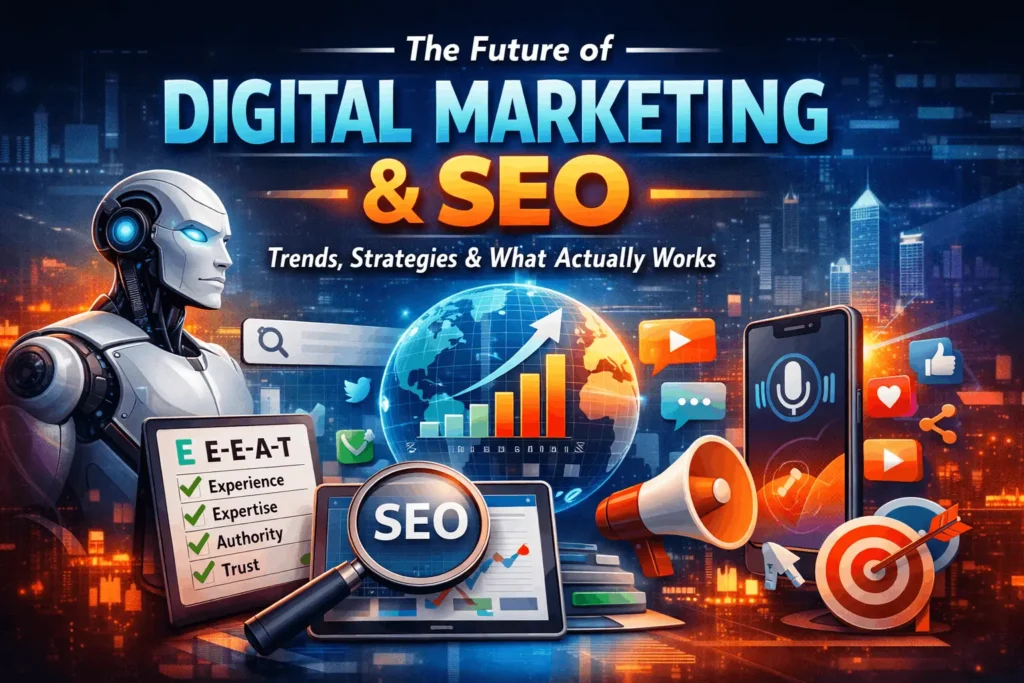
Digital marketing and SEO are no longer about tricks, hacks, or short-term wins. They are evolving into a discipline rooted in user trust, data intelligence, and real value creation. Businesses that still rely on outdated tactics—keyword stuffing, shallow content, or aggressive ads—are already falling behind.
This article explores the future of digital marketing and SEO from a practical, real-world perspective. It focuses on what users are truly searching for, why current strategies fail, and how brands can build long-term visibility, authority, and revenue in an increasingly competitive digital ecosystem.
Understanding the Real Search Intent Behind Digital Marketing & SEO
Before predicting the future, we must understand why people search for digital marketing and SEO insights in the first place.
The Core Problem Users Face
Most marketers, business owners, and creators struggle with:
Declining organic traffic despite “doing SEO”
Rising ad costs with lower returns
Rapid algorithm changes that feel unpredictable
Confusing advice from conflicting sources
The Root Cause
The digital landscape is shifting faster than traditional marketing education can keep up with. Search engines, social platforms, and users are all becoming more intelligent, selective, and experience-focused.
What Users Actually Want
Users aren’t just asking what the future is—they want to know:
How SEO will change with AI and automation
Whether content marketing still works
How to future-proof their online presence
Which skills will remain valuable long-term
This article answers those questions with clarity and realism.
How Digital Marketing Is Evolving Beyond Traditional Channels
The Problem
Traditional digital marketing models focus heavily on channels—SEO, PPC, email, social media—as isolated systems. This leads to fragmented strategies and inconsistent user experiences.
Why This Happens
Historically, platforms were simpler. Ranking on Google or running ads was enough to generate results. Today, users interact across multiple touchpoints before making decisions.
The Shift: Ecosystem-Based Marketing
The future of digital marketing is holistic. Search engines increasingly evaluate:
Brand signals
User engagement across platforms
Consistency of messaging
Trust indicators
SEO no longer works in isolation—it’s influenced by brand authority, content depth, and audience behavior.
Real-World Example
A service-based business may rank well temporarily with SEO alone. But a competitor with strong brand searches, helpful content, social proof, and expert positioning will eventually outperform it.
Expert Tip
Think less about “channels” and more about customer journeys. Every piece of content should support the same narrative.
Common Mistake
Chasing every new platform without strengthening core assets like the website, content quality, and brand credibility.
Prevention
Build a central digital hub (your website) that connects SEO, content, email, and social strategy seamlessly.
The Role of AI in the Future of SEO and Marketing
The Problem
Many marketers fear AI will replace SEO and content creators entirely.
The Reality
AI is not replacing SEO—it’s reshaping it.
Search engines already use machine learning to understand:
Search intent
Content relevance
Context and semantics
User satisfaction signals
How AI Changes SEO
AI-driven search prioritizes:
Meaning over keywords
Depth over volume
Helpfulness over optimization tricks
This means thin content, even if “optimized,” will lose visibility.
Practical Solution
Use AI as a support tool, not a replacement. It can help with:
Research and analysis
Content structuring
Pattern detection
Workflow efficiency
But human experience, insight, and judgment remain irreplaceable.
Realistic Scenario
Two articles target the same topic:
One is AI-generated and generic
The other includes real experience, examples, and expert insight
The second will consistently perform better long-term.
Expert Advice
Future-proof SEO content by adding:
First-hand experience
Original perspectives
Case-based explanations
Practical insights AI cannot fabricate
Mistake to Avoid
Publishing large volumes of AI-written content without human editing or expertise.
Content Quality Will Matter More Than Ever
The Problem
The internet is saturated with content. Publishing “more” no longer guarantees visibility.
Why This Is Happening
Search engines aim to reduce noise and surface the best answers, not the most frequent ones.
The Future Standard of Content
High-performing content will be:
Comprehensive
Context-aware
Experience-driven
Updated regularly
Length alone is not the ranking factor—usefulness is.
Example
A 2,000-word guide that solves a problem step-by-step will outperform five shallow 500-word posts.
Expert Tip
Every piece of content should answer:
Who is this for?
What problem does it solve?
Why should this page exist?
Common Mistake
Writing for algorithms instead of humans.
Prevention
Test content with real users. If it doesn’t help them, it won’t help SEO either.
E-E-A-T Will Define Long-Term SEO Success
Understanding the Issue
Google increasingly evaluates who is behind the content, not just the content itself.
What E-E-A-T Really Means
Experience: First-hand knowledge of the topic
Expertise: Demonstrated skill or understanding
Authority: Recognition within the field
Trustworthiness: Accuracy, transparency, and credibility
Why This Matters for the Future
As misinformation grows, search engines must prioritize reliable sources.
Practical Implementation
To strengthen E-E-A-T:
Showcase author credentials
Share real examples and insights
Cite reputable sources when relevant
Maintain consistent branding and messaging
Real Example
A digital marketing blog run by a practicing marketer with documented case studies will outperform a generic content site.
Mistake to Avoid
Hiding authorship or publishing anonymous, unsupported claims.
The Rise of Search Experience Optimization (SXO)
The Problem
Many websites rank but fail to convert or retain users.
The Cause
SEO has traditionally focused on traffic, not experience.
The Future Focus
Search Experience Optimization combines:
SEO
Content clarity
Conversion optimization
Search engines increasingly use engagement metrics to evaluate relevance.
Practical Solutions
Optimize for:
Page speed
Mobile usability
Clear structure
Easy navigation
Readable content
Example
A well-ranked page with poor readability will gradually lose visibility due to low engagement.
Expert Tip
Design pages for humans first, algorithms second.
Voice Search, Visual Search, and Zero-Click Results
The Challenge
More searches now end without clicks due to:
Featured snippets
Voice assistants
Knowledge panels
What This Means for SEO
Visibility doesn’t always equal traffic—but it still builds authority.
Future Strategy
Optimize for:
Conversational queries
Question-based searches
Structured data
Clear, concise answers
Real-World Application
Answering common user questions directly increases the chance of being featured.
Common Mistake
Ignoring zero-click searches entirely.
Prevention
Treat visibility as brand exposure, not just traffic metrics.
Digital Marketing Skills That Will Stay Relevant
Skills That Will Decline
Keyword stuffing
Low-effort content production
Platform-specific hacks
Skills That Will Grow
Strategic thinking
Data interpretation
Content storytelling
SEO fundamentals
User psychology
Expert Insight
Tools will change. Principles won’t.
Focus on understanding users, not chasing algorithms.
How Businesses Can Future-Proof Their SEO & Marketing Strategy
The Core Problem
Short-term thinking leads to long-term losses.
Sustainable Solutions
Invest in brand building
Create evergreen content
Focus on audience trust
Continuously update and refine strategies
Realistic Example
A brand that updates core guides annually maintains rankings for years, while competitors churn content endlessly.
Final Expert Advice
The future belongs to those who prioritize value, not volume.
Frequently Asked Questions (FAQ)
1. Will SEO still be relevant in the future?
Yes. SEO will remain essential, but it will focus more on user experience, content quality, and trust rather than technical tricks.
2. How will AI impact digital marketing jobs?
AI will automate repetitive tasks but increase demand for strategic, creative, and analytical roles that require human judgment.
3. Is content marketing still effective long-term?
Yes, but only high-quality, experience-driven content will succeed. Generic content will gradually lose visibility.
4. What is the biggest mistake marketers make today?
Focusing on short-term gains instead of building long-term authority and trust.
5. How can small businesses compete in future SEO?
By focusing on niche expertise, local relevance, and providing genuinely helpful content.
6. Are keywords still important for SEO?
Keywords still matter, but context, intent, and relevance matter far more.
7. How often should SEO strategies be updated?
Core principles remain stable, but strategies should be reviewed regularly to align with user behavior and platform changes.
Final Thoughts
The future of digital marketing and SEO is not uncertain—it’s simply misunderstood. Success will not come from chasing trends, tools, or loopholes. It will come from understanding people, solving real problems, and earning trust over time.