
How AI Will Replace Jobs and Create New Careers: A Complete Guide
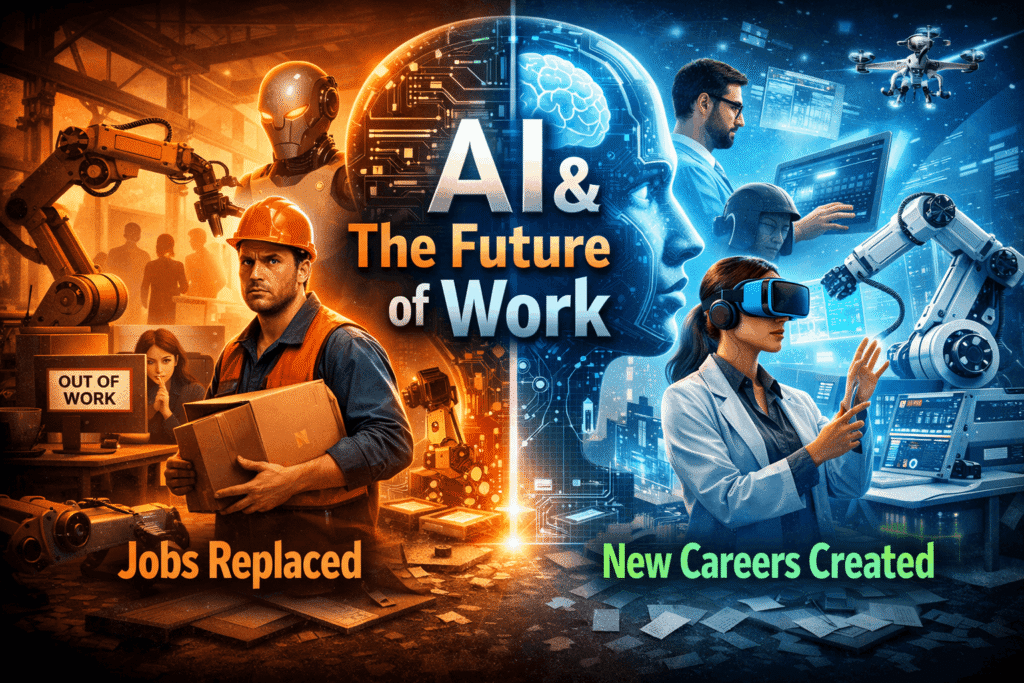
Artificial Intelligence (AI) is no longer just a futuristic concept—it has become an integral part of our daily lives and workplaces. From automating repetitive tasks to analyzing vast amounts of data, AI is reshaping the labor market at an unprecedented pace. While some fear massive job losses, others see AI as a catalyst for new career opportunities. Understanding how AI will replace jobs and create new careers is essential for workers, businesses, and policymakers who want to thrive in this evolving landscape.
In this comprehensive guide, we’ll explore the real impacts of AI on employment, the industries most affected, the types of careers AI is generating, and practical strategies to adapt. We’ll provide examples, expert advice, and preventive measures to help individuals stay competitive in the AI-driven economy.
Understanding AI and Its Role in the Workforce
What Is AI?
Artificial Intelligence refers to computer systems capable of performing tasks that normally require human intelligence. These tasks include problem-solving, decision-making, speech recognition, and visual perception. AI systems learn from data patterns and improve over time, allowing them to perform complex functions faster and more accurately than humans in certain contexts.
Why AI Is Changing Jobs
AI technologies are advancing rapidly, fueled by big data, cloud computing, and sophisticated algorithms. Organizations deploy AI to:
Reduce operational costs
Improve accuracy and efficiency
Handle repetitive or dangerous tasks
Enhance customer experiences
While these benefits are undeniable, they also mean that certain roles traditionally performed by humans may become redundant. However, the same technology also creates opportunities for entirely new careers and industries.
Jobs AI Is Replacing
Problem: Job Displacement
The most immediate concern with AI adoption is job displacement. Many workers worry that machines and algorithms will take over tasks that humans currently perform, leaving them unemployed or underemployed.
Causes: Why AI Replaces Jobs
AI is particularly effective at automating tasks that are:
Repetitive and rule-based (e.g., data entry, assembly line work)
Predictable and measurable (e.g., financial auditing, inventory management)
Standardized across multiple operations (e.g., customer support chatbots)
Examples of Roles at Risk
Some roles are more susceptible to AI-driven replacement:
Data Entry Clerks: AI software can input, organize, and validate data much faster.
Telemarketers: AI chatbots handle outbound calls and lead generation with conversational AI.
Manufacturing Workers: Robots and automated machinery reduce the need for manual labor.
Customer Service Agents: AI chatbots answer FAQs, resolve complaints, and even process returns.
Financial Analysts: AI can analyze market trends, detect fraud, and generate reports with minimal human intervention.
Mistakes to Avoid
Workers often make the mistake of assuming that AI will completely eliminate their jobs. The reality is more nuanced—AI replaces tasks, not entire roles in most cases. Understanding which tasks can be automated allows workers to reskill or shift focus to tasks that require creativity, critical thinking, and human empathy.
Jobs AI Is Creating
Problem: New Skills Gap
While AI may replace certain jobs, it simultaneously creates demand for new roles. The challenge is that these roles often require advanced technical knowledge, analytical skills, or cross-disciplinary expertise. Many workers struggle to bridge this skills gap.
Causes: Why AI Generates New Careers
AI introduces new tasks and challenges that humans are uniquely qualified to handle:
Developing, training, and maintaining AI systems
Interpreting AI-generated insights
Designing AI-human collaboration processes
Ensuring ethical, legal, and fair AI usage
Examples of Emerging Roles
AI Specialist/Engineer: Develops algorithms, builds AI models, and ensures systems run efficiently.
Data Scientist: Extracts meaningful insights from large datasets to guide business decisions.
AI Ethicist: Evaluates the social and ethical implications of AI applications.
Robotics Technician: Maintains and repairs automated machinery in manufacturing or healthcare.
Prompt Engineer: Optimizes prompts for AI language models to generate accurate and useful outputs.
AI Trainer: Teaches AI systems to recognize patterns, such as voice commands or images.
Tips for Entering AI-Created Careers
Upskill Continuously: Learn AI, data analytics, or robotics fundamentals.
Focus on Interdisciplinary Knowledge: Combining domain expertise with AI skills is highly valuable.
Build a Portfolio: Show practical experience through projects, internships, or freelancing.
Stay Updated: AI evolves rapidly; staying informed ensures long-term relevance.
Industries Most Affected by AI
Problem: Industry Disruption
AI’s impact varies across sectors, and workers in certain industries may face higher disruption risks.
Key Industries
Manufacturing: Automation reduces manual labor but increases demand for robotics technicians.
Healthcare: AI assists in diagnostics and record-keeping, creating roles in AI healthcare analytics.
Finance: Algorithmic trading and fraud detection reduce routine analyst work but open new opportunities in AI auditing and compliance.
Retail: Self-checkout systems and chatbots replace cashiers and customer service agents, while creating e-commerce AI strategy roles.
Transportation: Autonomous vehicles may reduce truck driver demand but increase roles in AI vehicle monitoring and fleet management.
Mistakes to Avoid
Assuming your industry is immune to AI is a common mistake. Even fields like education, law, and creative arts are seeing AI-assisted tasks, from grading assignments to drafting legal documents or generating preliminary design drafts.
How to Adapt to AI-Driven Job Changes
Problem: Career Uncertainty
Many workers feel anxious about AI replacing their jobs and wonder how to stay employable in the future.
Solutions: Practical Steps
Identify Tasks That AI Cannot Replace: Focus on creativity, complex problem-solving, interpersonal skills, and empathy.
Upskill and Reskill: Learn AI literacy, programming basics, data analysis, or digital marketing.
Embrace AI Tools: Use AI to enhance productivity rather than fear it.
Consider Freelancing or Entrepreneurship: AI creates niches for specialized services and consulting.
Develop Soft Skills: Leadership, negotiation, communication, and emotional intelligence remain human strengths.
Examples
A customer service agent could transition into AI customer experience manager, overseeing automated systems.
A manufacturing worker could train in robot maintenance or programming, leveraging existing industry knowledge.
A financial analyst could become an AI compliance specialist, combining finance expertise with AI auditing skills.
Preventive Strategies for Workers
Problem: Future Job Vulnerability
Even proactive workers may feel vulnerable without a strategic approach to AI integration in careers.
Solutions
Stay Informed About Industry AI Trends: Read industry reports, attend webinars, and join professional communities.
Focus on Continuous Learning: Short online courses, certifications, and workshops can keep skills relevant.
Diversify Your Skill Set: Blend technical, analytical, and human-centric skills to become indispensable.
Leverage AI for Personal Productivity: Using AI tools effectively enhances your value at work.
Mistakes to Avoid
Ignoring AI developments in your field
Believing automation will happen “someday” instead of now
Relying on outdated skills in a rapidly evolving job market
Real-World Examples of AI Job Transformation
Example 1: Manufacturing Automation
A car manufacturer introduced robotic assembly lines, reducing manual labor needs by 40%. However, it created hundreds of jobs in robot programming, system maintenance, and quality control—roles that require higher skill levels and pay more than the original positions.
Example 2: AI in Customer Support
A global retail brand replaced its basic customer service representatives with AI chatbots. Agents who previously handled routine inquiries were retrained to manage complex customer complaints, interpret AI insights, and improve chatbot performance—leading to more strategic, rewarding roles.
Example 3: AI in Healthcare
Radiologists using AI-assisted diagnostic tools can detect anomalies in medical imaging faster and more accurately. While some worry AI may replace radiologists, the reality is that these professionals now focus on critical decision-making, treatment planning, and patient communication, expanding their scope rather than reducing their relevance.
Tips for Thriving in an AI-Driven Career Market
Adopt a Growth Mindset: View AI as a tool for enhancement, not a threat.
Build AI Literacy: Learn basic AI concepts and applications relevant to your industry.
Network Strategically: Connect with professionals in AI-adjacent fields.
Focus on Human Skills: Creativity, empathy, and leadership remain irreplaceable.
Experiment with AI Tools: Practical experience gives you a competitive edge.
Common Mistakes Workers Make With AI
Overestimating AI Replacement: Believing entire jobs will disappear rather than specific tasks.
Ignoring Continuous Learning: Stagnation in skills can make workers vulnerable.
Avoiding AI Collaboration: Failing to integrate AI into workflows reduces efficiency and employability.
Focusing Only on Technical Skills: Ignoring soft skills and creativity limits career growth.
Future-Proof Careers in an AI World
High-Demand Roles Likely to Grow
AI & Machine Learning Engineers
Data Analysts and Scientists
AI Ethics Specialists
Human-AI Interaction Designers
Robotics Technicians and Engineers
Digital Transformation Consultants
Cybersecurity Experts (AI-driven security solutions)
Emerging Opportunities
AI will continue to create roles we cannot yet fully anticipate. For example:
AI-driven personalized education coaches
Autonomous vehicle safety supervisors
AI-assisted legal researchers
Human-AI collaboration coordinators
By focusing on flexibility, learning, and adaptability, workers can future-proof their careers in an AI-driven economy.
Conclusion: Embrace AI for Career Growth
Artificial Intelligence is transforming the workforce in profound ways. While some jobs are at risk of automation, new opportunities are emerging that demand creativity, critical thinking, and technical knowledge. By understanding which tasks are susceptible to AI, identifying emerging career paths, and continuously developing skills, workers can not only survive but thrive in the AI-driven economy.
The key is to embrace AI as a collaborator, not a competitor. Those who adapt early, learn proactively, and leverage AI to enhance human capabilities will lead the workforce of tomorrow.
FAQ: AI and Jobs
1. Will AI completely replace human workers?
No, AI primarily automates specific tasks, not entire jobs. Roles requiring creativity, empathy, and strategic thinking remain human-led, while AI augments efficiency.
2. Which industries are most affected by AI?
Manufacturing, customer service, finance, transportation, and healthcare are among the most impacted. However, AI affects nearly all industries indirectly.
3. What skills are most valuable in an AI-driven job market?
Technical skills (AI literacy, data analysis), soft skills (creativity, communication), and interdisciplinary knowledge are highly valuable.
4. How can I prepare for AI-driven career changes?
Stay informed about industry trends, reskill in AI-relevant areas, leverage online courses, and focus on tasks AI cannot perform, such as problem-solving and leadership.
5. Are AI-created careers sustainable long-term?
Yes, careers such as AI engineers, data scientists, AI ethicists, and human-AI collaboration specialists are expected to grow as AI adoption increases across sectors.
6. Can AI help me advance in my current role?
Absolutely. Learning to use AI tools to automate repetitive tasks, analyze data, or enhance decision-making can significantly improve productivity and career growth.
7. What mistakes should workers avoid with AI adoption?
Avoid ignoring AI developments, underestimating the importance of soft skills, resisting collaboration with AI tools, or assuming your current role is safe from automation.